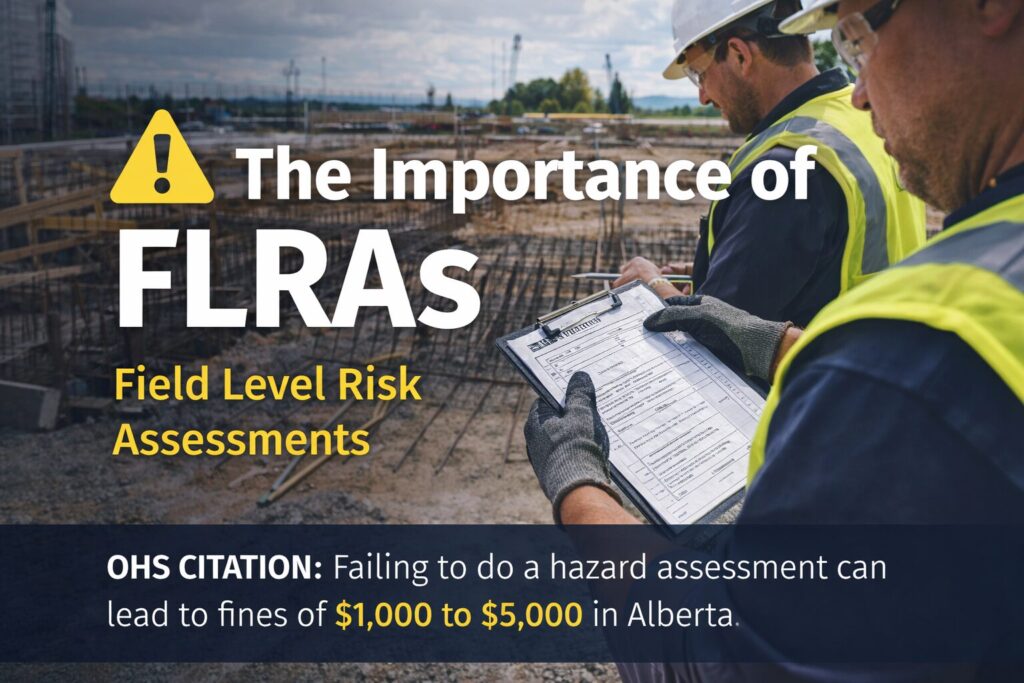
Field Level Risk Assessments (FLRAs) — sometimes also called Field Level Hazard Assessments (FLHAs) or Job Safety Analyses — are a cornerstone of effective workplace health and safety programs. On Alberta worksites, a properly performed FLRA does more than satisfy process checklists—it helps protect workers, reduce preventable incidents, and ensure compliance with regulatory requirements under Alberta’s Occupational Health and Safety (OHS) legislation.
In this post, we explain what FLRAs are, how they reduce risk, and why they matter under Alberta’s OHS Code. We also cite real enforcement examples to show what can happen when hazard assessments are not done or documented properly.
What is a Field Level Risk Assessment?
A Field Level Risk Assessment (FLRA) is a hazard assessment that takes place at the worksite, before work begins, and whenever conditions change. Its purpose is to identify hazards that may not have been anticipated during planning and to ensure appropriate control measures are in place.
According to the Council of Oilfield Associations (COAA), an FLRA is “a documented process used to identify hazards and assess potential risks associated with workplace tasks.” This becomes especially important when standard procedures or plans do not fully reflect on-the-ground conditions.
Alberta’s Occupational Health and Safety Code requires employers to assess hazards and implement controls before work starts and to reassess those hazards whenever work conditions change.
Why FLRAs Reduce Risk and Improve Compliance
FLRAs support safety programs in three key ways: they improve hazard recognition at the worksite, strengthen communication among workers and supervisors, and create documented records that are essential during inspections or audits.
Here’s how:
1. On-the-Spot Hazard Recognition
Pre-task hazard assessments performed near the actual work area help crews recognize site-specific hazards that may not be captured in broader job planning documents.
2. Real-Time Controls
FLRAs encourage teams to confirm that existing controls are effective — and to adjust them if conditions change.
3. Better Communication
Completing an FLRA together ensures that all workers understand the risks and controls before work starts.
FLRAs and Alberta OHS Requirements
In Alberta, hazard assessments are part of the legal duties employers must meet to protect workers. The Occupational Health and Safety Code says that employers must assess hazards and implement controls before work begins and again when conditions change — a requirement that aligns with the purpose of FLRAs.
Failure to properly document and perform hazard assessments can lead to enforcement action. The Government of Alberta publishes examples of administrative penalties issued under the OHS Act, and some of these penalties relate to incomplete or missing hazard assessments. For example, fines have been issued for failing to prepare a hazard assessment and to report its results as required.
While these examples reflect administrative penalties (often starting in the low thousands), they represent only a portion of potential consequences. More serious non-compliance — such as repeated failures or harms that occur because hazards weren’t controlled — can lead to larger fines and heightened regulatory scrutiny.
Real-World Consequences of Skipping FLRAs
Beyond formal penalties, failing to do proper hazard assessments can result in:
- Increased incidents and near-misses
- Higher insurance costs
- Project delays due to unsafe conditions
- Loss of contractor credentials or certifications
- Damage to reputation
In many cases, poor documentation is highlighted during incident investigations or third-party audits as a contributing factor — not necessarily the cause, but something that made it harder to determine why an incident occurred or how it could have been prevented.
Common Missteps and How to Avoid Them
Many organizations think they are doing FLRAs, but in reality, what they complete is an informal discussion with little documentation. To make your FLRAs effective and defensible:
- Start every task with an FLRA — don’t rely on generic plans alone.
- Document it consistently — use a standard form or digital tool.
- Involve the crew — hazard recognition is better when more eyes see the work area.
- Re-evaluate with every change — weather, tools, personnel, or methods can introduce new hazards.
Making FLRAs Easier Through Digital Tools
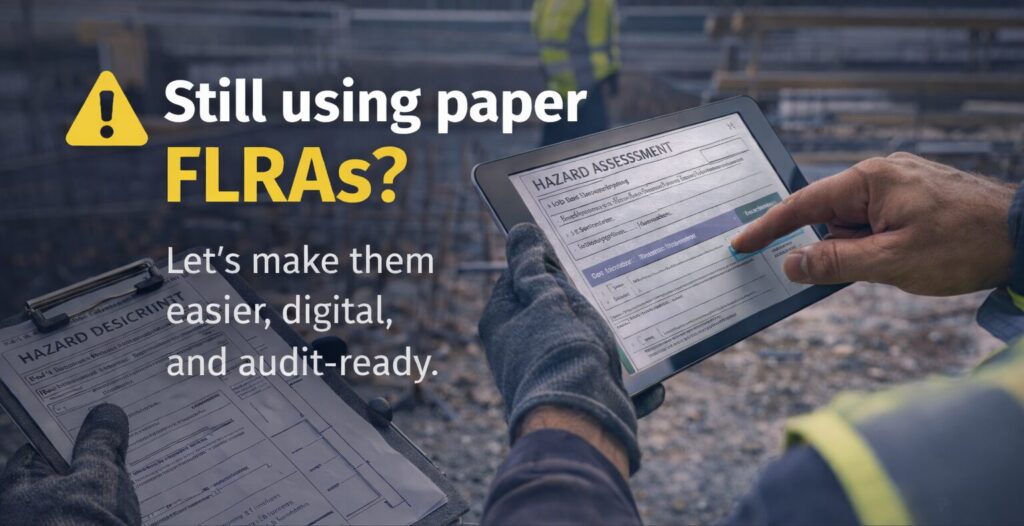
While FLRAs are a critical safety and compliance requirement, one of the most common challenges companies face is execution. Paper forms are often rushed, completed after the fact, or lost altogether. Handwritten FLRAs are difficult to track, hard to review, and frequently create gaps when auditors or inspectors request documentation.
At JADR Safety Consulting, we help companies simplify and strengthen their FLRA process by moving it into practical, digital workflows. Using established safety platforms such as Workhub, doForms, and SiteDocs, we help organizations replace paper-based hazard assessments with consistent, traceable, and audit-ready digital systems.
This approach aligns with industry guidance from Energy Safety Canada, which emphasizes hazard identification and risk management as foundational elements of effective safety programs in the energy sector. Energy Safety Canada identifies field-level hazard assessment as a key control to prevent incidents before work begins.
https://www.energysafetycanada.com
Similarly, the Canadian Association of Geophysical Contractors (CAGC) highlights the importance of hazard assessment and field-level risk management in geophysical and seismic operations, where changing terrain, weather, equipment, and crew configurations introduce dynamic risks that must be addressed at the worksite.
https://www.cagc.ca
Digital FLRAs make it easier to:
- Complete hazard assessments consistently before work begins
- Capture site-specific hazards in real time
- Ensure supervisors and workers actively participate in the process
- Store records securely and retrieve them quickly during audits or inspections
- Demonstrate compliance with Alberta OHS hazard assessment requirements
These platforms allow FLRAs to be completed on mobile devices in the field, reducing administrative burden while improving accuracy and accountability. More importantly, they support the intent of FLRAs promoted by organizations like Energy Safety Canada and CAGC — identifying hazards and implementing controls before work starts, not after an incident or inspection.
How Digital FLRAs Support Alberta Compliance
From a compliance perspective, digital FLRAs help address one of the most common enforcement issues: poor or inconsistent documentation. Alberta OHS administrative penalties frequently reference failures to prepare, update, or document hazard assessments. Digital systems improve traceability and help demonstrate that hazard assessments were completed as required.
From an industry standpoint, organizations such as Energy Safety Canada and CAGC consistently promote proactive hazard identification and worker engagement as core elements of effective safety management systems. Digital FLRAs support these expectations by making hazard assessment part of normal work execution rather than an afterthought.
Practical Support from JADR Safety Consulting
JADR Safety Consulting supports companies by:
- Reviewing existing FLRA and hazard assessment processes
- Aligning digital FLRAs with Alberta OHS, COR/SECOR, and industry guidance from Energy Safety Canada and CAGC
- Helping select and configure digital platforms such as Workhub, doForms, or SiteDocs
- Aligning digital FLRAs with Alberta OHS and COR/SECOR requirements
- Training supervisors and crews on practical, field-ready use
- Ensuring records are audit-ready and defensible
The goal is not to add complexity, but to remove friction — making it easier for crews to do the right thing while strengthening compliance and audit readiness.
Conclusion
Field Level Risk Assessments are a legal and practical requirement for Alberta worksites. When done properly, they reduce risk, improve communication, and create defensible safety records. When done poorly—or not at all—they increase exposure to incidents, enforcement action, and audit findings.
By combining strong safety processes with practical digital tools, organizations can make FLRAs easier to complete, easier to manage, and easier to defend. That is where effective safety systems move from paperwork to real protection.
References
• Energy Safety Canada – Safety Program and Hazard Management Guidance
• Canadian Association of Geophysical Contractors (CAGC) – Safety and Operations Guidance
• Alberta OHS Code, Part 2 — Hazard Assessment, Elimination, and Control
• Alberta OHS Administrative Penalties
Book a consultation to review your current FLRA process and identify practical improvements.
If your FLRA process still relies on paper forms, spreadsheets, or inconsistent completion, we can help. JADR Safety Consulting works with Alberta-based companies to implement practical, digital FLRA systems using platforms like Workhub, doForms, and SiteDocs—making hazard assessments easier to complete, easier to track, and easier to defend during audits or inspections.